Collection: Premium Matcha Tea from Japan

Keiko Uchida’s matcha collection brings together exceptional Japanese teas selected through her long-standing relationships with tea makers, farmers and traders in Japan. It includes teas from respected names such as Ippodo, Marukyu Koyamaen and Hoshino Seichaen, as well as Keiko’s own organic matcha and rare single-origin teas from Kyoto and Uji. From  We hope you enjoy exploring the collection, and we are always happy to help you choose a matcha online or at our Notting Hill store.

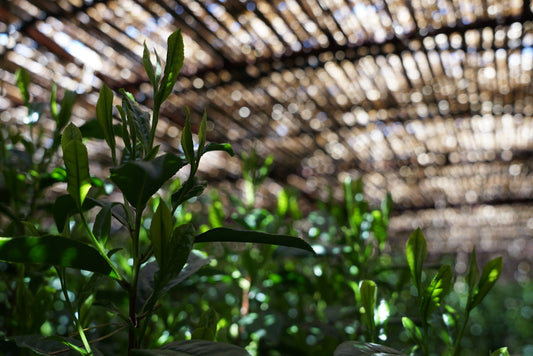
In contrast, there are other teas in Japan which are grown under direct sunlight, which encourages the leaves to grow quickly. These can be harvested up to 4 or 5 times a year. These leaves are thicker and tougher, dark green in colour with a bitter taste, and the powder is machine-made. In Japan this tea is called ‘green tea powder’, and is often used for baking. It is not regarded as high quality enough to be called ‘Matcha’. Outside of Japan however, on the international market, this kind of green tea is widely called Matcha, as there is no internationally agreed definition in force (such as there is for example with Champagne).

Within Japan there is no such thing as ‘Ceremonial Matcha’. This is purely a Western marketing phrase, and possibly refers to a grade of tea intended for the tea ceremony. It is not a helpful description, as it has
no clear definition. The only truly useful definitions with reliable meanings are ‘Matcha tea’ and ‘Green tea powder’, as they are applied in Japan. Using these, consumers can properly select their preferred tea, taking into account taste, purpose and price point.

It seems profoundly unfair, both to the consumer and to the authentic Matcha tea farmers, that Green tea powder, produced much more easily and cheaply, can be marketed as ‘Matcha tea’ so widely in shops, supermarkets and online in the West.

Needless to say, all our collections of Matcha tea are of the highest Japanese standard, and we are meticulous about ensuring how we describe and name all of our products.

The Health Benefits of Matcha Tea
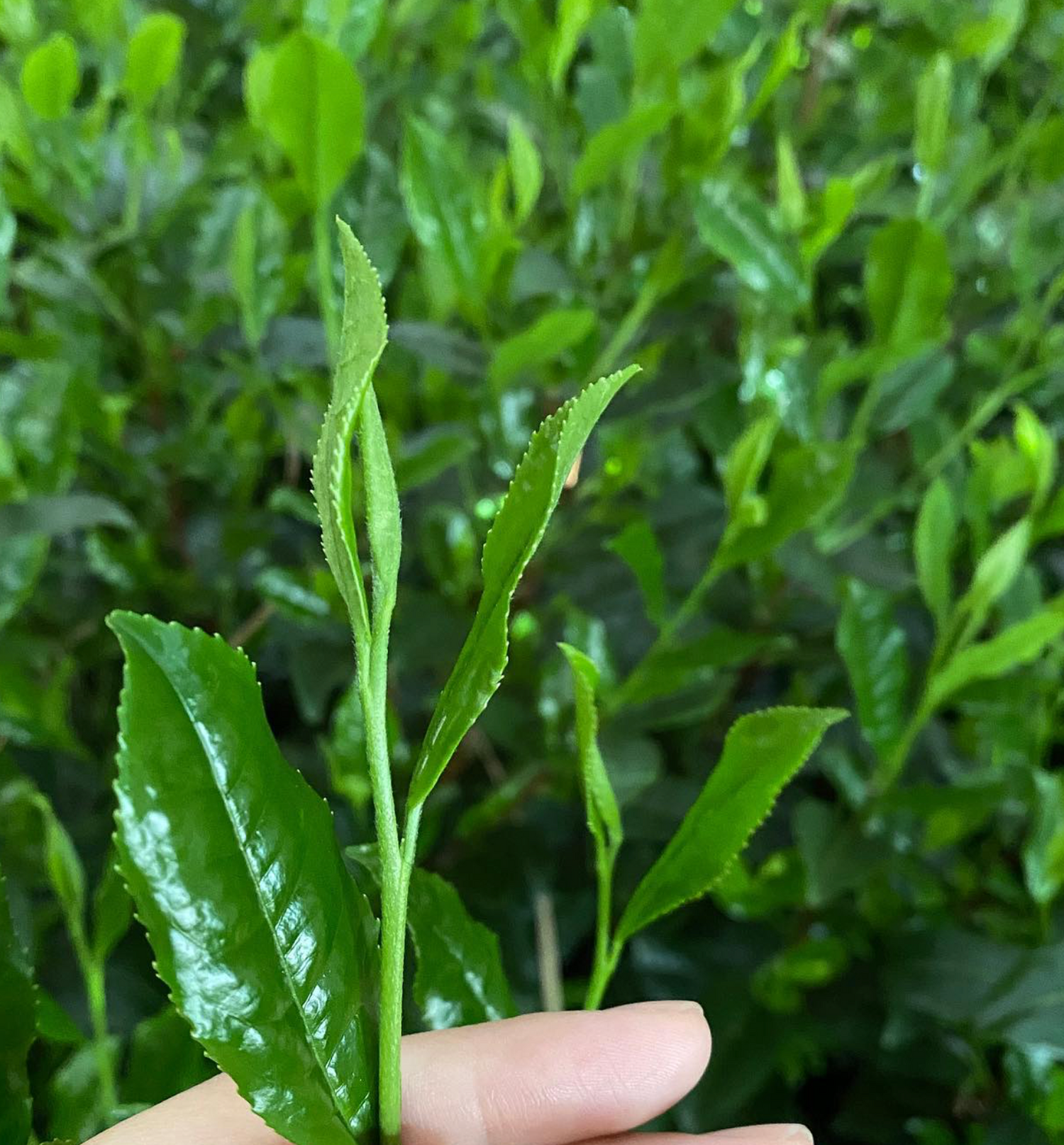
By tradition, Matcha tea has always been thought of as vitalizing and health-giving. When it was first consumed, in the 12th century, it was drunk as a medicine, and ever since it has been associated with a significant range of health benefits.

Many studies, including recently, have claimed a wide
variety of curative properties for Matcha tea. When the myths have been dispensed with, what is clear is that Matcha does have powerful medicinal properties,
containing as it does large amounts of Vitamin C and anti-oxidants, which provide some protection from free radicals and cell deterioration and disease. Regular drinking of Matcha tea has also proved to be beneficial for cholesterol management.

As Matcha is made entirely from green tea, with its
high nutritional levels, it is perfect for inclusion in a Vegan diet. By the 15th century Matcha tea had also
begun to form the heart of the Japanese Tea Ceremony, being developed as part of Bhuddist Zen ritual by Japanese monks, and has been central to the Tea Ceremony ever since. The Tea Ceremony was conceived just as much in spiritual and meditative terms as it was as a drink and medicine, and the history and meaning of the Tea Ceremony makes connections with our five senses, the harmonies of nature and the quest for self-knowledge and spiritual well-being.

In the 16th century it was common for high-ranking Samurai warriors to practice the Tea Ceremony in order to reduce anxieties from the traumatic memories of the battlefield. In the present day, many people savour a cup of Matcha Tea as a delicious healthy drink, also enjoying the process of making tea itself, which may also reduce stress levels.

It is a drink entwined with traditions and ideas of wellness and spiritual health, with powerful medicinal properties of its own: a way of life that helps us physically, just as the Tea Ceremony itself can help us mentally and spiritually.

How we source our Matcha Tea

We work with very best tea makers and tea farmers in
Japan in order to source our premium Matcha teas.

On Keiko’s frequent visits to Japan she regularly
seeks out small family-owned tea farmers, discovering new estates and developing existing relationships with farmers, to find the best organic practices and teas, and to be able to source fairly and honestly.  

 She also has a long-established working relationship
with Marukyu Koyamaen, arguably the best Matcha tea maker in the world, who she meets with on a regular basis. Most of the tea ceremony teachers in Japan use Marukyu Koyamaen’s Matcha teas for their lessons.

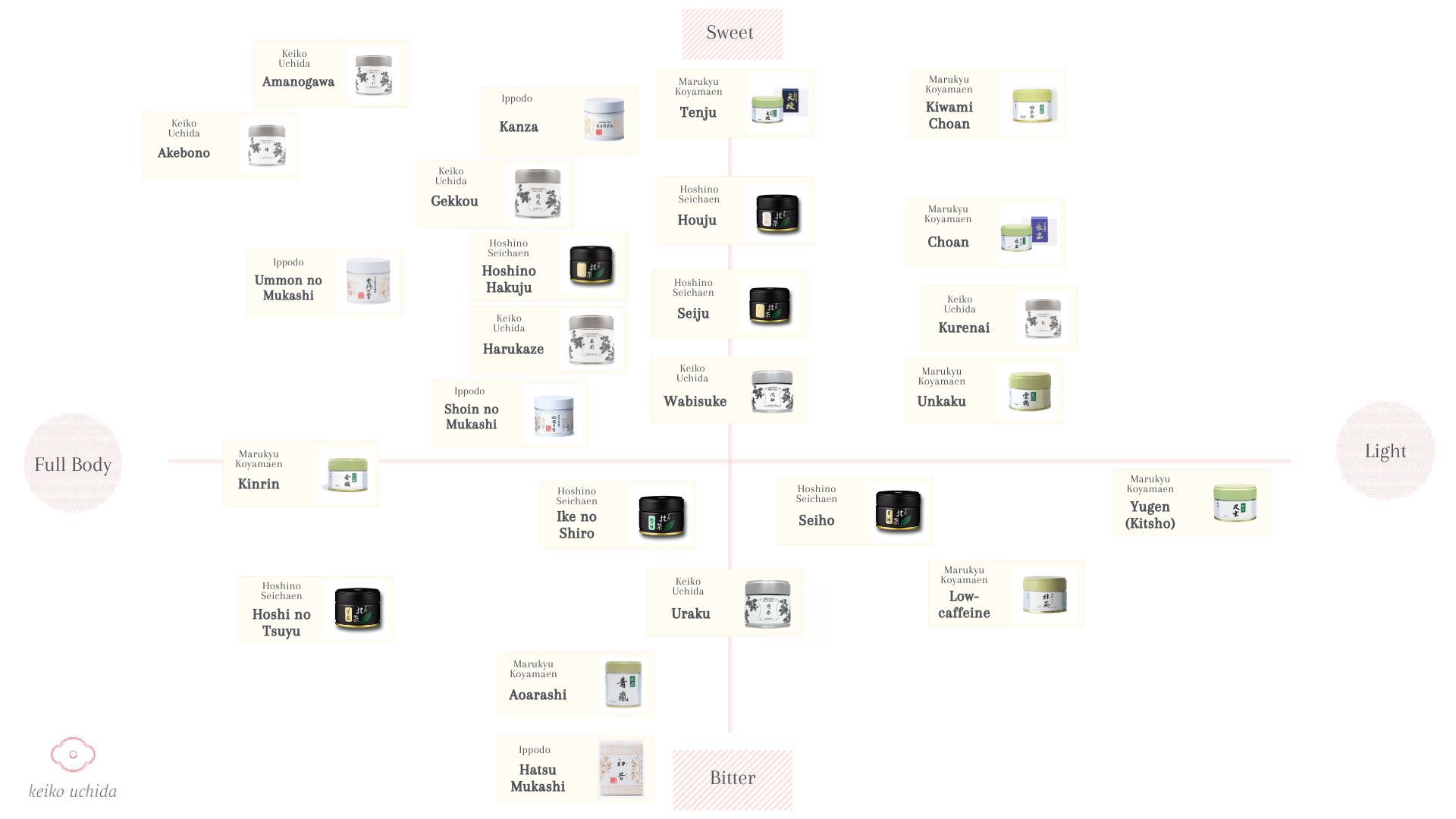
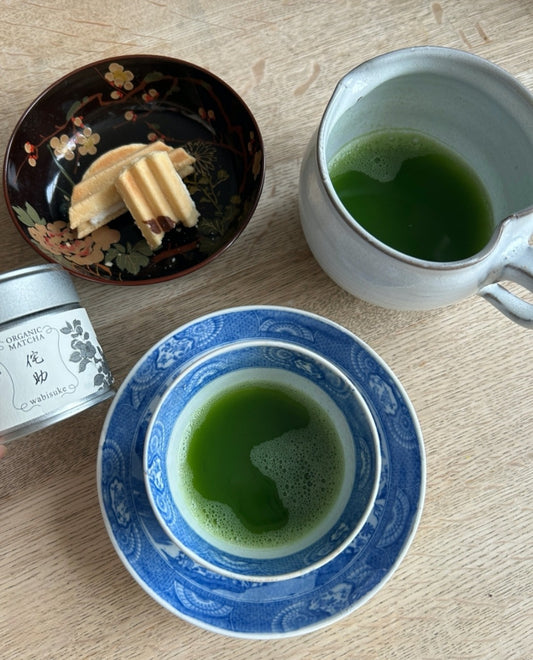
Keiko Uchida’s own brand Organic Matcha Teas have similarities in taste to the teas of Marukyu Koyamaen. Keiko’s own tea maker has strong ties with Marukyu Koyamaen, and shares similar ideas about composition and flavour. As stocks of Marukyu Koyamaen’s Matcha tea can sell very quickly this is worth noting, as Keiko Uchida’s Organic Wabisuke and Uraku, with their similar Kyoto flavours, can make very suitable alternatives.

Purchasing our Premium Collection Matcha Teas

You can find Keiko Uchida’s Premium Collection Matcha Teas in store or online. There are over 25 varieties of Matcha tea available, which is (we’ve been told) one of the largest selections of top quality Matcha tea in Europe. The teas are popular and the stock can sometimes move quickly, though we constantly try and make sure we have strong supplies of our own special branded organic Matcha teas. Our highly knowledgeable staff will always be on
hand and happy to help you select a special tea for you from the collection.

Find your favourite Matcha

Frequently Asked Questions

What is ceremonial grade matcha?

The term ‘ceremonial grade’ is more a blanket marketing term and you would not find it used in Japan. It is marketed as matcha suitable for traditional Japanese tea ceremonies, implying high quality. However, there are no strict regulations or definitions governing this term. As a result, not all "ceremonial grade" matcha is necessarily of superior quality. It's important to check the source and production methods to ensure you're getting truly high-grade matcha.

Why do matcha prices vary so much?

The price of matcha varies due to factors like growing conditions, harvest time, and production methods. Top-grade matcha is made from younger, hand-picked leaves, shaded for longer to enhance flavour and nutrients, and stone-ground slowly for quality, which raises costs. Lower grades use more mature leaves, harvested multiple times a year, and are often machine-ground. Authentic matcha is harvested only once a year in May, never in summer or autumn. Some brands release limited edition seasonal matcha which means it was stone-ground and blended with that season in mind.  To learn more about this, read our blog post about different grades of matcha.

Does higher-priced matcha always mean better taste?

Higher-priced matcha does not always guarantee a better taste, as personal preference plays an important role. Some people may prefer the stronger flavours of mid-grade matcha, while others enjoy the delicate sweetness of higher grades. Cheaper matcha, however, is often more bitter, as it may not be produced with the same care, and is sometimes better suited to milk or sweeteners.

What is the difference between stone-ground matcha and non-stone-ground matcha?

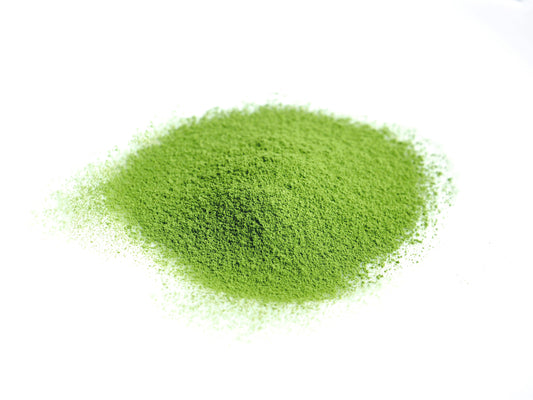
Stone-ground matcha is made by slowly grinding tea leaves between granite stones, helping to preserve its delicate flavour, nutrients and fine texture.

Non-stone-ground powders are usually produced by machine, which can beat or crush the leaves rather than slowly grinding them. This creates a very different flavour and texture. In Japan, this kind of powder is generally understood as green tea powder rather than true matcha. You can read more about this in our guide to the difference between top-grade and lower-grade matcha.